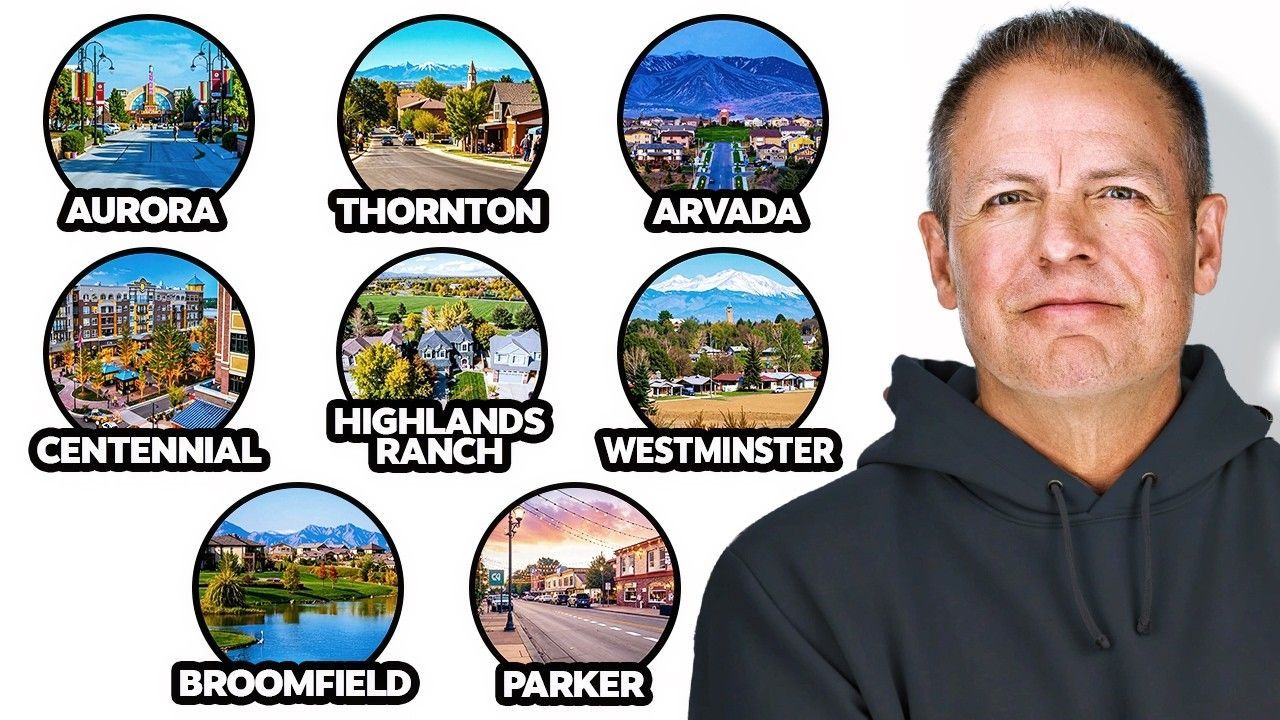

Denver Suburbs Ranked: The Best and Worst Places to Live
If you are moving to the Denver metro, you already know the big problem. Every suburb has a different vibe, different school outcomes, different commute patterns, and different long term value. But most people make the same mistake.
They shop for price instead of fit.
Here is the uncomfortable truth that keeps coming up in real transactions. Families sometimes pay 40 to 50 percent more in one part of the metro for the same square footage they could get elsewhere. Not because the home is better. Because the zip code is different. That means you can waste money without even realizing it.
After helping families for about a decade, the biggest lesson is simple. Success is not about finding the best suburb. It is about matching your lifestyle and budget to the right category of suburb.
Below is a ranked guide to some of the most discussed areas around Denver, from luxury privacy to smart affordability and real growth. It is based on the factors that actually matter day to day and over time.
Table of Contents
- Intro How to Choose the Right Denver Suburb
- Castle Pines Denver Suburb Guide
- Aurora Denver Suburb Guide
- Arvada Denver Suburb Guide
- Greenwood Village
- Broomfield Denver Suburb Guide
- Thornton Denver Suburb Guide
- Highlands Ranch Denver Guide
- Parker Denver Suburb Guide
- Littleton Denver Suburb Guide
- Louisville Denver Suburb Guide
- FAQs About the Best and Worst Denver Suburbs
- Final Thoughts on the Best and Worst Denver Suburbs
Intro How to Choose the Right Denver Suburb
Before the rankings, you need a framework. Denver suburbs are not interchangeable. They fall into different categories, and each category is built around a different promise.
Think in categories, not just names.
- Luxury privacy suburbs where land, custom builds, and school quality drive pricing.
- Value and access suburbs where affordability and transportation unlock daily convenience.
- Master planned family ecosystems where schools and community design protect long term demand.
- Employment adjacency suburbs where jobs drive appreciation even when the home price looks reasonable.
- Built out historic and infill suburbs where there is little room to expand, so what exists becomes more valuable.
- Controlled growth communities where open space and city planning limit what can be built.
Once you pick your category, the suburbs become easier to evaluate. You stop chasing hype and start planning with clarity.
Castle Pines Denver Suburb Guide
Picture driving through Castle Pines and feeling like you stepped into Colorado Beverly Hills. This is not cookie cutter housing. This is custom estate territory.
What makes Castle Pines feel different
Castle Pines is about 25 miles south of downtown Denver. Homes often start around 800,000, but many buyers end up in the millions.
What really stands out is the land. You are not dealing with postage stamp lots. These properties sit on actual land, sometimes one acre or more. That rarity matters in Denver, where newer development often means tighter footprints.
And the lifestyle is built around convenience. People choose Castle Pines because they can hop onto I 25 and be downtown or at the Denver Tech Center quickly.
Modern infrastructure plus high end recreation
Castle Pines is one of the newer cities in the state, so the infrastructure is modern, including underground buried utilities. That kind of design tends to age better than “patchwork” neighborhoods.
There is also a serious golf culture. The Country Club at Castle Pines is consistently ranked among Colorado best.
Schools and taxes that protect the investment
Rock Canyon High School is cited with a 9 out of 10 rating. Property taxes run about 0.51 percent of home value. On a 1.2 million home, that is roughly 6,100 per year.
Bottom line: If your top priorities are privacy, space, and investment protection while living like you are on vacation, Castle Pines fits the bill.
Aurora Denver Suburb Guide
Aurora gets a rough reputation. But the data points toward something else. Aurora is one of the smartest affordability moves in the Denver metro right now.
Affordable home prices without giving up access
With about 386,000 people, Aurora is Colorado third largest city. The big selling point is affordability.
Its median home price is around 480,000, which is about 120,000 less than the metro average. In some pockets, like near Havana, you can see starter homes around 350,000.
Want something newer and more upscale near E 470? You might pay closer to 600,000, but that is where you typically get brand new construction.
Transportation that changes how daily life feels
This is where Aurora separates itself. There are six light rail stations between the R line and the H line. You can get direct routes to I 225, I 7, and E 470.
Meanwhile, people in some western suburbs are sitting in traffic for an hour, while residents in Aurora are already at desks.
Neighborhoods matter more than the city name
Yes, Aurora has rough spots, especially in parts near Montbello and some areas of Kfax. But there are also master planned communities like Saddle Rock and Tallyn's Reach.
There are also major economic anchors. The Gaylord Resort brings serious convention business. Aurora also has multiple warehouses, and there is a major new development called Aurora Highlands that is about 3,100 acres of new everything.
Utilities and commute impact
Aurora property taxes are about 0.55 percent, and Aurora runs its own utilities, so monthly bills can beat Denver proper.
If you work at National Jewish or other major campus locations like DIA and Buckley, commute time can shrink dramatically.
Bottom line: Aurora can be a great value play, but the secret is neighborhood selection.
Arvada Denver Suburb Guide
Arvada is one of those places that feels like a secret until you see it from the street level.
Old town energy you can feel
Every Friday night in summer, Old Town Arvada comes alive with live music, busy patios, and kids enjoying ice cream. Many Denver residents do not realize it is only about 20 minutes away.
Arvada has about 124,000 people across 35 square miles. Median home price sits around 585,000. That is not “cheap,” but it often gets you more lifestyle per dollar than expected.
Access to outdoor life
Golden is about 35 minutes away. You do not even need to leave town for outdoor fun because Clear Creek runs through the city. People even fly fish on lunch breaks.
The G line connects to Union Station in about 20 minutes. You also have easy access to I 7 and Highway 93.
Schools and key development driver
Pomona High School is cited with an 8 out of 10 score.
The big story is Candelas, a massive development covering about 1,500 acres on the west side of town. Over the next decade, the plan calls for about 5,000 homes. Townhomes can start around 550,000, with custom builds going over a million.
Arvada has about 125 parks and roughly 90 miles of trails.
Bottom line: Arvada tends to attract families who want mountain access without living in the mountains, plus city benefits without the biggest city headaches.
Greenwood Village Denver Guide
If you want to understand Greenwood Village Denver Guide , start with the schedule. This suburb has a daily rhythm that is almost comically different from other “sleepy” luxury towns.
80,000 people flood in for work
About 16,000 people live in Greenwood Village, but roughly 80,000 people flow in every weekday for work.
So the place becomes a buzzing business hub around 9:00 a.m., then quiets down again by dinner time.
Why it is not “just wealthy”
Most people lump Greenwood Village in with other wealthy Denver suburbs. But the real point is that it is basically the Denver Tech Center backyard.
The area has about 15 million square feet of office space packed into just 8.5 miles.
Home prices and the reality of exclusivity
The median home price is around 915,000, but that can be misleading because it includes condos.
For the most desirable pockets like Cherry Hills Farms and areas near the Glenmoor Country Club, pricing often starts above 2 million.
Inventory is extremely limited. A recent count showed only about 15 homes for sale in the city. When something decent appears, buyers move aggressively, including cash offers around 20 percent over asking.
City rules that preserve the land
Years back, Greenwood Village put tighter development rules in place, with many areas requiring one acre minimum lots. That is a major reason exclusivity stays intact.
Bottom line: Greenwood Village is less about “getting a deal” and more about buying into a proven, long standing lifestyle and school environment with extremely limited supply.
Broomfield Denver Suburb Guide
Broomfield is where the “smart play” energy lives. People overlook it because it is not as famous at dinner parties, but the employment and growth story is hard to ignore.
Perfect location without Boulder prices
Broomfield sits about 16 miles from Denver and 16 miles from Boulder. The transcript frames that as strategy, not luck.
Over 75,000 people live there, and median home prices are around 625,000.
On paper, that sounds “normal” until you look deeper.
Interlocken and job density
Interlocken is the key. It is described as Colorado second biggest employment center after downtown Denver, with roughly 30,000 jobs. Average salaries are cited around 95,000.
It is not only tech either. Even when tech slows, many people stay local through satellite work or medical development.
Appreciation and the city structure
One of the most compelling numbers is appreciation. The transcript cites 7.2 percent annual appreciation for five straight years, while Denver County is around 5.3.
Broomfield became its own city and county in 2001. That matters because it can speed up implementation when development and infrastructure decisions are on the table.
The B Line connects to Union Station, and the Northwest Rail Line is expected by 2028. That gives residents multiple transit options in the future.
Why families buy here
Families in Broomfield are described as chasing neither prestige nor hype. They are chasing access to job density without the price premiums of Boulder.
The expectation is straightforward: more high paying jobs in one area tends to support property value growth.
Bottom line: Broomfield is a “work plus home value” suburb that can make your money do more work.
Thornton Denver Suburb Guide
Thornton is the one that people blow past on I 25 without a second thought. That might be the biggest mistake in the metro for value seekers and investors.
Median price and home finding ranges
Thornton is cited with a median home price around 510,000. That feels like a win compared with nearby high demand areas.
Neighborhoods like Holly Park and Green Gables may still have options under 450,000.
Commute advantage changes the comparison
Instead of focusing on downtown Denver commute time, the transcript emphasizes a newer math. If you work for employers in the Thornton adjacency, you can have dinner while others sit on I 25.
Examples mentioned include Lockheed Martin, Ball Aerospace, and DIA related employers.
New construction in Quebec Highlands and The Gardens is mentioned in the 550,000 to 650,000 range.
The zip code premium benchmark
A striking data point is that the exact same builder and floor plan can cost about 20 percent more in Westminster or Broomfield.
Same house type. Different pricing pressure.
Why it can work for investors too
The transcript also ties Thornton to commercial investment. The Denver Premium Outlets development is described as massive, essentially creating a new downtown, and it was picked in Thornton not Lone Tree or Highlands Ranch.
Investor math included:
- Three bedroom rentals around 1,900 to 1,950 per month on average
- Property taxes around 0.54 percent which is described as the lowest in the metro area
- Crime down 15 percent in the last three years
- Population about 145,000, still relatively under the radar
Bottom line: Thornton is described as “not flashy, just smart,” and a place where real wealth can build quietly.
Highlands Ranch Denver Guide
Now let us talk about Highlands Ranch , the suburb people compare everything to. This is where families treat school quality like it is the Olympics.
School performance as the main demand engine
Highlands Ranch is known for consistent high school outcomes. Examples mentioned include Rock Canyon, Mountain Vista, and Thunder Ridge, with all cited scoring eight or above.
More importantly, Highlands Ranch has five high schools and they are described as all crushing it. That is unusual. Most suburbs pray for one strong school.
The transcript also attributes this to a community built by about 96,000 education obsessed people and a master planned structure across about 22,000 acres in Douglas County.
Home pricing with long term stability
Median price is cited around 675,000. That is not cheap. But the claim is that when families compare Highlands Ranch to typical suburbs, they often miss what the premium buys you.
Highlands Ranch operates like a small universe with 32 different neighborhoods, each with its own personality. For example:
- Back Country feels mountain like
- Eastridge is described as young family centered
- Firelight is where executives tend to live
Graduation rates and value protection
Within Highlands Ranch boundaries, the transcript cites:
- 16 elementary schools
- 5 middle schools
- 5 high schools
- 95 percent graduation rate
- Top 10 statewide SAT scores
The key takeaway is that the school brand helps keep home values stable. Even during the 2008 downturn, Highlands Ranch allegedly paused and then kept climbing.
Taxes and HOA reality
Property taxes with metro districts are described around 65 percent, and HOA costs are about 1,800 per year. That sounds high, but the argument is that it replaces costs that would otherwise be paid separately.
Bottom line: Highlands Ranch is for families who want everything handled, strong schools, and predictable long term demand.
Parker Denver Suburb Guide
Parker is where the growth story gets even more interesting, especially because it is tied to something most people do not talk about.
The overlooked advantage water rights
The transcript frames Parker as a place that just secured water rights for about 50,000 more homes. In Colorado, the implication is that water is harder to secure than premium season tickets to the Broncos.
That kind of resource lock can change everything, because development is not just about wanting to build. It is about being able to build.
Fast population growth
Five years ago, the population was cited as about 45,000. Today it is around 58,000. That is described as an explosion, not just incremental growth.
Median price starts around 625,000. Cottonwood townhomes start around 425,000. The Pinery is mentioned at around 2.3 million.
Downtown Parker and the second Parker plan
Parker kept older western buildings from the 1800s, but updated the inside with craft breweries and farm to table spots.
Parker Days draws about 250,000 people to a town of 58,000.
The big commercial and infrastructure story is a long term plan described as:
- 20 miles of area
- 3,100 acres
- 7,500 homes
- 2 million square feet of commercial space
- a proposed new hospital
Charles Schwab is mentioned as planning for about 2,000 jobs. The Parker Tech Center is also adding office space.
Appreciation rate
Annual appreciation since 2020 is cited around 8.1 percent. The claim is that a 600,000 house from 2020 could be over 800,000 today.
Bottom line: Parker is portrayed as a place that could follow the Highlands Ranch growth playbook, but moving faster.
Littleton Denver Suburb Guide
Littleton is doing something very different. It is not expanding into empty land. It is extracting value from what is already there.
Built out and getting harder to find
The transcript describes Littleton as essentially built out, with about 48,000 people living across roughly 13 square miles. There are no empty fields and no phase 2 coming soon signs.
That means the existing housing stock is becoming scarcer.
Median home value is cited around 595,000, which sounds reasonable until you remember it is about 10 miles from downtown Denver.
Chatfield Reservoir as backyard value
Chatfield Reservoir is positioned as a backyard, and it is about 5 minutes away.
Why older homes can be a gold mine
A key point is that many 1970s ranch homes are being gutted and rebuilt, but the older “bones” can be valuable. The transcript mentions original hardwoods, quarter acre lots, and trees older than most suburbs.
Contractors are described as saying those bones beat many homes built after 1990, when materials and framing practices were different.
Main Street and true walkability
Littleton Main Street is described as thriving. Examples include:
- The ViewHouse with a two hour wait for Sunday brunch
- Bridge Brewery flagship nearby
- Angelos for fancy Italian
- Hudson Gardens hosts concerts that sell out and do not charge admission
- The Littleton Museum is free
The article also emphasizes true walkability, meaning you can walk to things without needing fake walkable behavior where you still have to drive.
School district nuance
School district boundaries can be tricky. Most areas are described as pulling solid sevens from Little Public Schools, but certain streets can land you in Cherry Creek territory.
The street you pick matters, because test scores can differ.
Bottom line: Littleton is a scarcity plus lifestyle play, where older homes on good lots can become high demand refreshes.
Louisville Denver Suburb Guide
Louisville can be a strange one because it sits in that Boulder orbit, but it is not trying to become a bigger version of anything.
Pronunciation matters
First things first, it is Louisville, not Lewisville. Pronounce it wrong and everyone knows you are not from here.
Controlled growth that keeps things “perfect”
The transcript cites Money Magazine calling Louisville the number one place to live in Colorado. But the explanation is less about marketing and more about planning.
Louisville stays controlled by limiting growth. The town is described as having about 21,000 people living on roughly nine square miles between Boulder and Broomfield.
There are no annexation plans and limited expansion opportunities. The city is described as building a wall of open space around the city and saying we are done.
Home price reality
Median home price is cited around 765,000, but that includes condos. The more honest expectation is that you typically are not finding a decent detached house under 800,000.
Historic downtown and high end new builds
Downtown is described as having old mining cottages now renovated into historic gems around 800,000, including features like Tesla chargers in restored carriage houses.
Steel Ranch has new builds starting around 900,000, and Davidson Mesa is where pricing gets intense, with custom homes on multi acre lots running 2 to 4 million.
Open space locked inside city limits
The strongest value argument is that about 2,000 acres of open space is locked inside city limits, which is roughly 35 percent of the town that can never be developed.
Harper Lake supports paddle boarding. The Cole Creek Trail connects to Boulders system, and you can bike toward Boulder without seeing a car.
Bottom line: Louisville is a “finished and determined” community. You are buying a place that intends to stay that way.
FAQs About the Best and Worst Denver Suburbs
How do I choose the right Denver suburb if prices vary a lot?
Stop comparing only median prices and start matching your lifestyle to a suburb category. Then evaluate the demand drivers that protect value for that category, like school performance, job density, transit access, and whether the neighborhood has limited supply.
Is Aurora a good value compared to other Denver metro areas?
Aurora is often positioned as a value play because its median home price is cited around 480,000 and is backed by transit options like light rail lines. The key is choosing the right neighborhood, since conditions vary across the city.
Why does Greenwood Village stay so expensive?
Primarily because of limited inventory, strong school outcomes, and city rules that restrict overdevelopment. The area also functions as the Denver Tech Center backyard, so work adjacency keeps demand steady.
What makes Broomfield different from nearby cities like Boulder?
Broomfield is positioned as close to both Denver and Boulder while offering a lower entry price. The Interlocken employment center and strong appreciation numbers are presented as key reasons demand remains high.
Should investors focus on Thornton instead of Highlands Ranch?
The transcript frames Thornton as “smart” for investors because of development momentum, lower property tax rates in the metro range, and rental pricing that can create cash flow. Highlands Ranch can be great for homeowners, but investor returns may differ based on purchase price and demand.
What is the main reason Highlands Ranch holds value?
High school consistency and education performance. Multiple cited high schools score eight or above, and school outcomes are described as protecting value through market downturns.
Why does the transcript emphasize water rights for Parker?
Because water is a limiting factor for future development. Securing water rights for thousands of homes can unlock growth and infrastructure planning, which can support long term appreciation.
Is Littleton a good choice if I want more of a lifestyle than a long commute?
Littleton is described as a lifestyle and scarcity play. It is relatively built out, close to Denver, and includes strong local amenities like Chatfield Reservoir and walkable Main Street. Home value can also benefit when older homes on larger lots are renovated.
What makes Louisville different from other Boulder adjacent towns?
Controlled growth and permanently protected open space. The transcript highlights that a large share of the town is open space that can never be developed, which supports long term neighborhood character and scarcity.
Final Thoughts on the Best and Worst Denver Suburbs
Here is the takeaway that ties all of these suburbs together. Every suburb is someone perfect fit. The mistake is shopping for price only, without understanding the lifestyle category you are buying into.
The difference between a great decision and a costly mistake is knowing which neighborhoods are about to pop and which ones have already peaked. That requires more than a list of home prices. It requires matching your needs to the underlying demand engines: schools, jobs, commute reality, inventory, infrastructure, and resource constraints like water.
If you are serious about moving to the Denver metro, it is time to plan early. Markets move fast, and the best opportunities get picked up quickly.
And if you want help narrowing it down to the right neighborhoods for your budget, lifestyle, and timing, call or text me at 720-459-4226 so you are not making a decision under pressure.
READ MORE: Living in Denver: Reasons People Love Calling It Home

Gary Bradler
Gary is your trusted partner in the residential real estate market of Denver, Colorado. With years of experience, he is dedicated to helping buyers, sellers, and investors navigate the dynamic landscape, whether you’re a first-time buyer or a seasoned investor.
WATCH THE LATEST VIDEOS